
2026 State of HR in Canadian Senior Living: 5 Key Takeaways

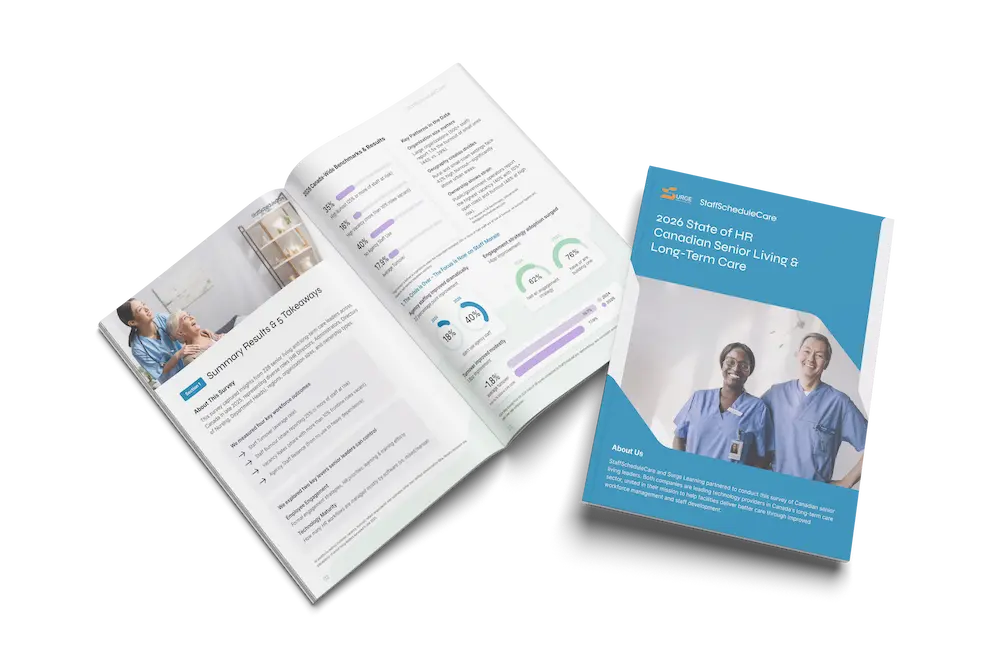
To better understand where senior care and long term living stands today, StaffScheduleCare and Surge Learning surveyed 228 company leaders across Canada. The research explored turnover, burnout, vacancy rates, agency staffing reliance, employee engagement strategies, and HR technology adoption.
Results revealed a sector transitioning from crisis response to long-term workforce sustainability. While turnover and agency usage are improving, burnout and operational strain remain significant challenges, especially for larger organizations and rural operators.
Below are five of the most important findings from the research and what they mean for senior living leaders moving forward.
To access the report highlights and explore all five findings in detail, click below.
The Crisis Has Eased, But Staff Morale Is Now the Priority
One of the clearest findings from the survey is that many organizations are no longer operating in pure crisis mode.
Average turnover improved from 19.7% in 2024 to 17.9% in 2026, while the percentage of organizations avoiding agency staff entirely increased from 18% to 40%. At the same time, formal employee engagement strategies rose sharply, increasing from 62% adoption in 2024 to 76% in 2026.
As staffing pressures begin to stabilize, leadership priorities are shifting. Staff morale and wellness now rank as the top workforce priority, surpassing hiring and recruitment for the first time.
This marks an important transition for the sector. Organizations are increasingly focused on retaining and supporting the employees who stayed through years of disruption, burnout, and operational strain.
To access the report highlights and explore all five findings in detail, click below.
Employee Engagement Strategies Are Delivering Measurable Results
The research found that organizations with formal engagement strategies consistently report lower burnout levels.
In medium and large organizations, burnout rates dropped by as much as 15.6 percentage points when engagement initiatives were in place. However, the most successful organizations were not relying on a single universal program. Instead, they tailored their approaches to their teams’ specific needs and culture.
Common engagement initiatives included:
- Recognition and appreciation programs
- Team connection and culture-building efforts
- Wellness initiatives
- Flexible scheduling and work-life balance improvements
- Regular communication and feedback
- Professional development opportunities
The data suggest that workforce stability is increasingly tied to employee experience, not just recruitment volume.
To access the report highlights and explore all five findings in detail, click below.
Technology Adoption Dramatically Reduces Operational Chaos
Organizations with stronger HR technology adoption reported significantly better workforce outcomes.
Facilities that automated three or more HR workflows saw burnout rates fall from 40% to 17%, while heavy agency reliance dropped from 13% to just 2.4%.
The largest gains were seen in organizations that fully committed to operational automation rather than relying on partial or mixed manual processes. Homes still managing critical workflows manually often continued experiencing scheduling bottlenecks, staffing disruptions, and manager burnout.
The findings reinforce a growing reality across senior living: operational efficiency and workforce stability are now deeply connected.
To access the report highlights and explore all five findings in detail, click below.
Shift Filling Remains the Sector’s Biggest Operational Gap
Nearly half of surveyed organizations identified shift filling automation as their top operational priority, yet only 19% currently have automated solutions in place.
This gap is having a direct impact on workforce stress and agency dependency.
Organizations with shift filling automation reduced heavy agency usage by 84%, significantly improving scheduling efficiency while reducing last-minute staffing disruptions.
For many operators, shift filling remains the source of daily operational chaos:
- constant call-outs
- weekend coverage gaps
- excessive manager workload
- employee frustration around fairness and scheduling transparency
The research suggests this may be one of the highest-leverage operational improvements available to senior living organizations today.
To access the report highlights and explore all five findings in detail, click below.
The Highest-Performing Organizations Combine Technology and Engagement
Only 12% of Canadian senior living organizations reported having both strong technology adoption and formal employee engagement strategies in place.
However, those organizations dramatically outperformed their peers across nearly every workforce metric.
Compared to organizations with lower technology adoption and no engagement strategy, these high-performing operators reported:
- Burnout rates of just 14%
- Zero heavy agency dependence
- Lower vacancy rates
- Stronger workforce stability overall
The findings suggest that sustainable workforce improvement requires both operational systems and people-focused leadership working together.
Organizations investing in only one side of the equation are unlikely to see the same long-term results.
To access the report highlights and explore all five findings in detail, click below.
What Can You Do?
Our team of experts is here to help. Looking to validate your company's approach or get buy-in for new initiatives? Let's talk. To access the report highlights and explore all five findings in detail, click below.